 Shivam
If your goal is weight loss, this question comes up sooner or later:
“Should I just walk every day, or do I really need to join a gym?”
The honest answer is not extreme, and not the same for everyone.
Weight loss depends on consistency, lifestyle, and sustainability, not just calories burned in one hour.
Let’s break it down clearly so you can decide what actually works for you.
Walking vs Gym: The Core Difference (Simple Explanation)
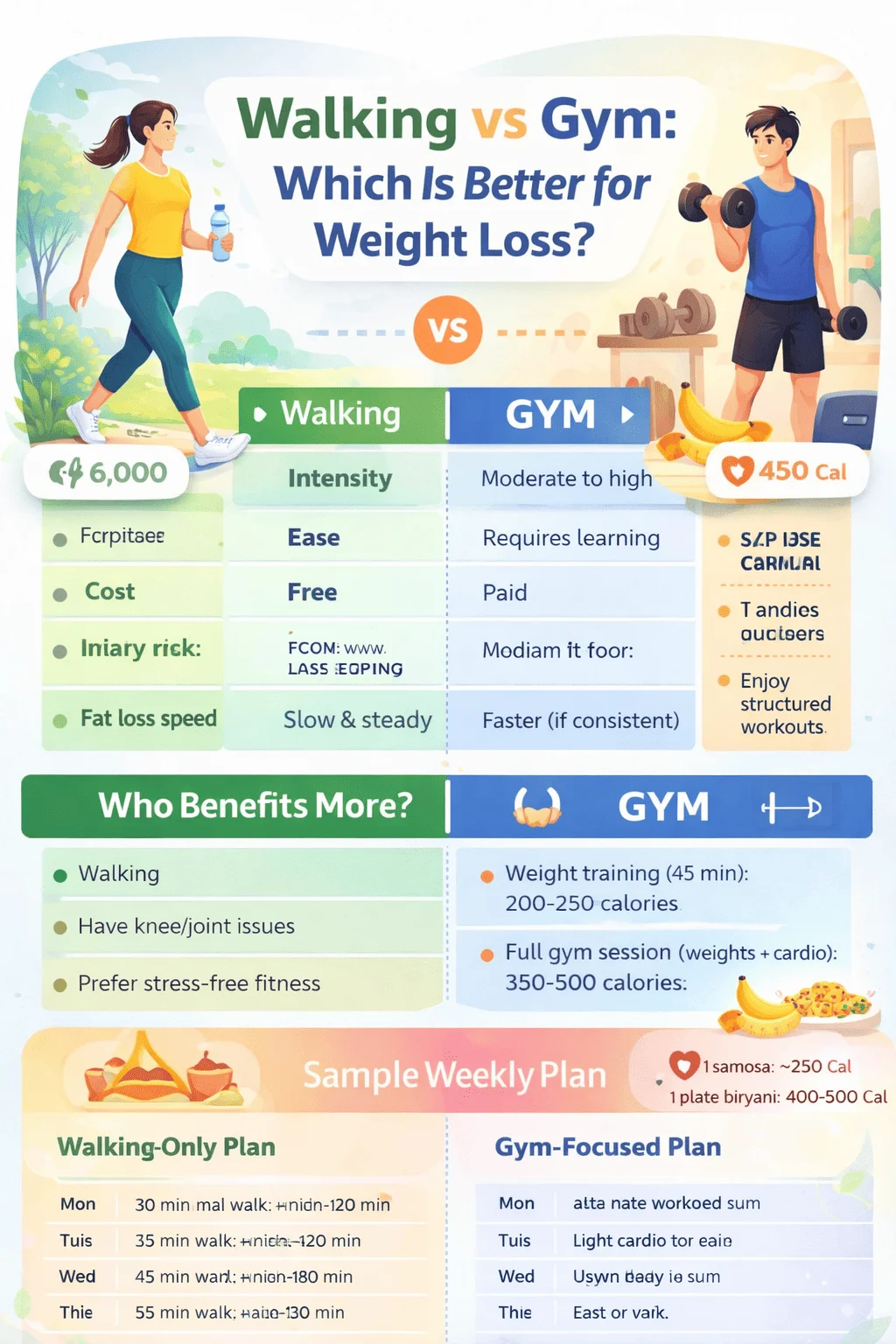
| Factor | Walking | Gym |
|---|---|---|
| Intensity | Low to moderate | Moderate to high |
| Ease | Very easy | Requires learning |
| Cost | Free | Paid |
| Injury risk | Very low | Medium if done wrong |
| Sustainability | Very high | Depends on habit |
| Muscle building | Minimal | High |
| Fat loss speed | Slow & steady | Faster (if consistent) |
👉 Walking is lifestyle-based fat loss
👉 Gym is performance-based fat loss
Both work but for different people.
Who Should Choose Walking for Weight Loss?
Walking is underrated – but extremely effective when done consistently.
Walking is best for you if:
-
You are overweight or obese
-
You are just starting your fitness journey
-
You have knee, back, or joint issues
-
You feel intimidated by gym environments
-
You can’t commit to strict schedules
-
You want a stress-free, long-term habit
Real-life example
Many people who start walking daily for 45–60 minutes lose weight steadily — because they don’t quit.
No soreness.
>No excuses.
That consistency beats intense workouts done once a week.
Who Benefits More From the Gym?
The gym is powerful if used correctly.
Gym is better if:
-
You already have basic fitness
-
You enjoy structured workouts
-
You want faster visible results
-
You want to build muscle + lose fat
-
You can commit at least 3-4 days per week
-
You are willing to learn proper form
Why gym helps weight loss faster
-
Strength training increases muscle mass
-
More muscle = higher resting calorie burn
-
HIIT + weights = strong metabolic effect
But only if you’re consistent and not overdoing it.
Common Mistakes Beginners Make (Very Important)
❌ Walking mistakes
-
Walking too slowly with no increase over time
-
Walking randomly without duration targets
-
Assuming walking cancels poor diet
-
Not tracking steps or time
❌ Gym mistakes
-
Copying advanced workouts from Instagram
-
Lifting heavy without learning form
-
Training daily without recovery
-
Ignoring diet and sleep
-
Expecting results in 2 weeks
👉 Weight loss fails more due to bad expectations than bad workouts.
Walking vs Gym: Which Burns More Calories?
Approximate comparison (for 70–75 kg person):
-
45 min brisk walking: 180–220 calories
-
45 min gym (weights + cardio): 300–450 calories
Yes, gym burns more per session.
But walking wins if:
-
You do it daily
-
You don’t skip
-
You don’t quit
Weekly consistency matters more than single-session burn.
Sample Weekly Plan (People Love This Part)
Option 1: Walking-Only Plan (Beginner-Friendly)
| Day | Activity |
|---|---|
| Mon | 40 min brisk walk |
| Tue | 45 min walk + stretching |
| Wed | 40 min walk |
| Thu | 50 min walk |
| Fri | 40 min walk |
| Sat | Long walk (60 min) |
| Sun | Rest or light walk |
👉 Best for beginners, busy people, and long-term fat loss.
Option 2: Gym-Focused Plan
| Day | Activity |
|---|---|
| Mon | Full body workout |
| Tue | Light cardio or walk |
| Wed | Upper body + core |
| Thu | Rest or walk |
| Fri | Lower body workout |
| Sat | Cardio or HIIT |
| Sun | Rest |
👉 Best for faster results if you stay consistent.
Option 3: Best of Both Worlds (Recommended)
| Day | Activity |
|---|---|
| Mon | Gym (strength) |
| Tue | 40 min walk |
| Wed | Gym |
| Thu | Walk |
| Fri | Gym |
| Sat | Long walk |
| Sun | Rest |
This combination works for most people.
So… Walking or Gym? The Honest Answer
Ask yourself this:
“Which one can I do consistently for the next 6 months?”
If the answer is “4435” data-end=”4446″>walking — start walking.
>If the answer is data-end=”4490″>gym — join the gym.
>If you can do both — that’s ideal.
👉 The best workout is the one you don’t quit.
Weight loss is not about punishment – it’s about building a system your life can handle.